Alexa Hampton’s new book, Alexa Hampton: The Language of Interior Design (Clarkson Potter) makes no bones about the fact that, in Ms. Hampton’s view, interior design follows rules, has its own grammar and is something that, if worked at with sufficient diligence, can be learned. She herself, not always a willing pupil, was “dragged” by her famous father, Mark Hampton, all around every important house in Europe but despite throwing up at Giverny, says she is indebted to him for a formidable bank of knowledge upon which she now draws for her own very successful design career.
For an interior design book, the writing is almost brisk (“Don’t try too hard to do things that have never been done”) but it is also lucid and helpful. Eighteen homes are used to illustrate the principal elements of a distilled design philosophy that relies upon four basics: contrast, proportion, color, and balance. Though the interiors featured vary from a New Orleans 1840’s Greek Revival house to a beach house, they do share a certain formality and control in line with the design tenets expressed in the book although there are moments of exuberance such as the peachy Palm Beach Romantic home.

There are too, glimpses of a lively personality intriguingly at odds with the restraint evident in many of the interiors. When the author writes about her own home she confesses: “I actually sold my Volkswagen to be able to afford to have the chair made by the famous New York upholsterer Guido de Angelis (Of course at the time my husband thought I was crazy. Now he knows I am, but in that instance I was right.)
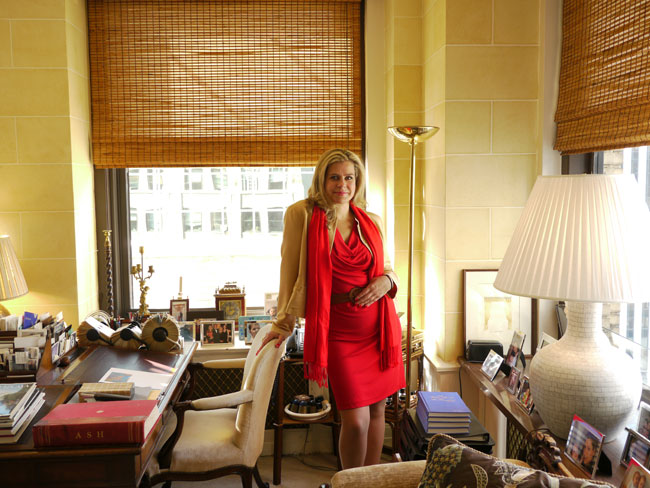
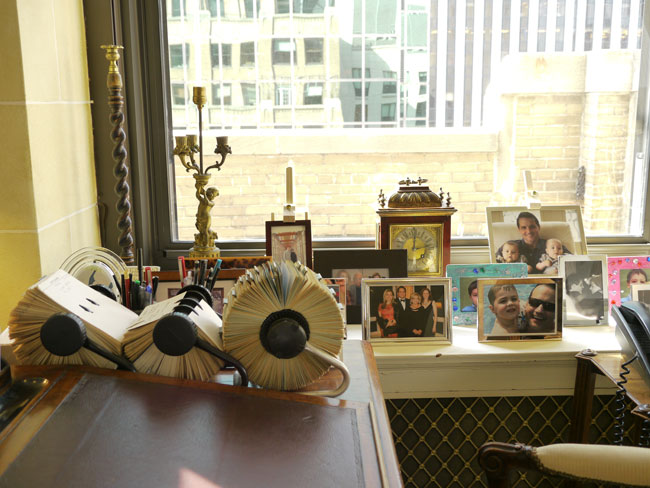
Sian met with Alexa in her office, which to this day is furnished with her father’s belongings. She is both fun and no nonsense—an enviably energetic mother of three who admits to being something of a split personality: “I’m outgoing, gregarious, silly and bawdy, but my work isn’t.”
Can you tell us how you went about deciding what to put in the book?
I believe in rules. There is a language of design that you need to learn, that’s what I have to offer. I call it counter-programming.
But there are a lot of “how to” books out there…
This is definitely not a ‘how to’ book but there are way to make design less mystifying—breaking design down into approachable steps.
Unfortunately, learning the rules doesn’t always make for a great designer.
Yes, but it’s a start.
However there are some great designers that don’t have formal training…
Yes, but they can’t convey the process to others, which is what I’m doing in the book. If it’s entirely intuitive … then it’s intuition—and you can’t articulate it. Design doesn’t need to be so opaque. There are hallmarks—you can communicate [the concepts of] contrast and color.


But I do think you need to also break rules, don’t you?
Absolutely, once you master the rules then you need to break them.
Isn’t the world of design very different now? People don’t take their designer’s word as the ‘be all and end all’.
Well, It should never be that a client is dictated to by their designer. We can be filtered. Hopefully we are conduits for that person to express themselves.


If you haven’t grown up with a visual language, isn’t it hard to have the language of design in your head?
We are now empowered because there is so much available through the internet. Many people think they can do what professional designers do—there is freedom. But now I do think people will go back to getting a designer to help them pull everything together.
You don’t want it to be overwrought
So when you walk into a person’s apartment can you immediately know that person?
I think there is information to be had, but often it’s incomplete. We could have a long conversation about New York women wearing black, whatever that means.
Of course, I need to ask you about your father. How old were you when he passed away?
Twenty-seven. It totally hit me over the head. He got sick in February and died in July.


Did you have time to mourn or did you fell pressure to pick up the pieces and go on with the business immediately?
It has helped that I had to go to work and that I couldn’t just crawl into bed. I could do that at night but not 24/7 ….death is difficult no matter what. I don’t think my situation is any better or worse than anybody else who has lost a person they love.
Yes, although it all really fell to you to pick up the pieces in his design business—that’s a lot of pressure.
I had to keep I going. Lucky me to have a business that was already up and running and there were already projects and clients to continue with. But other new clients came to me when I was still in my late twenties.
Did any of your clients say, “Just do what your father would have done”?
Oh no, I don’t think anyone would have had the nerve to say that. That wouldn’t have been easy. However I did keep the name Mark Hampton Design.


I read that your mother and father dragged you around to museums. Was it boring?
It had its moments but I was Quaker and you’re raised to bear with it.
Do you do the same with your children?
A little bit. I recently dragged them around the Acropolis. One of my three-year-old twin sons asked me why it was crumbling and the other one is overlooking the view and I’m explaining everything in detail and all of a sudden he says, ‘Mom, look there’s a taxi!’



Oh that’s so funny—a real NYC kid. Are you ever going to cave in take them to one of these kid-friendly resorts?
Well, I always will stay at a place with a pool but no, no Club Med. Having said that we want to balance it with fun.
How do you do that?
I have no idea.
You have a particularly full plate, no?
Well, I have a lot of things you could say I’m doing all at once. I like to joke with my friends that my goal is not to do any one thing very well.
That’s a great thing to say. It’s impossible to be perfect at everything.
Perfection doesn’t exist, but Tina Fey on 30 Rock is pretty close!